
The Tell-Tale Heart
Friday, 26 December 2014 posted at 04:40
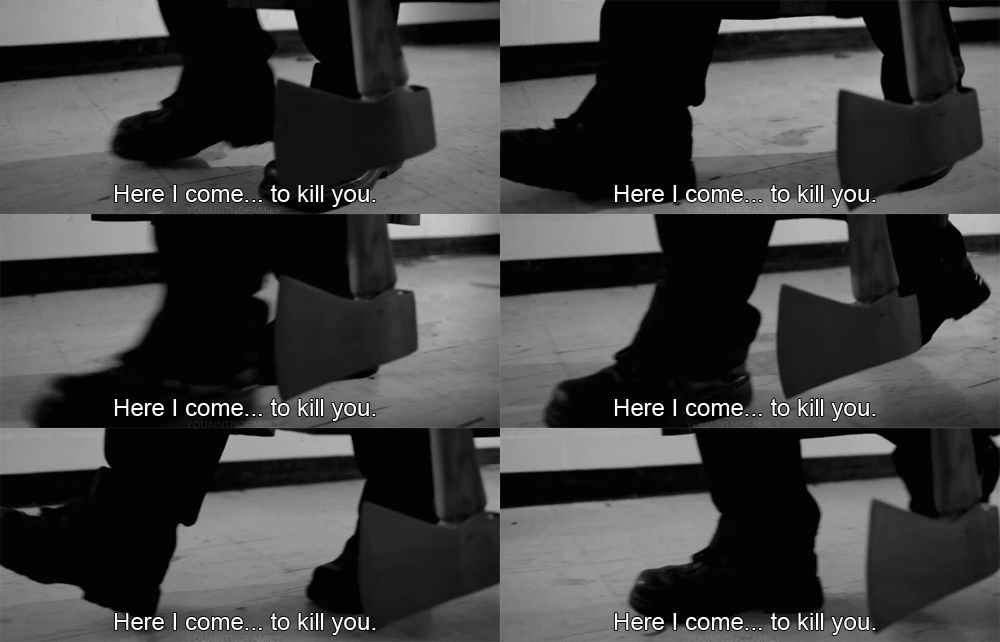
The tell tale heart
is a tale of horror. It reflects psychology of a killer. He kills an old man
just because he does not like the old man’s vulture-like eye. The reason is not
sound enough for a murder. But the murderer is not a mad man. He commits the
murder concisely and very methodically. He goes to the old man’s house around
midnight with a muffled light. He pushes the bedroom door open just a little
and finds the man in his bed. The old man wakes up. The killer waits few
minutes. Then he again peeps in and finds the old man lying awake. He looks at the
old man’s vulture eye with disgust and bursts in. He pulls the old man off his
bed and overturns the heavy bed on him. In this way he smothers( ) the old man
to death. Then he chops the dead body into pieces and conceals the pieces under
the wooden boards of the floor.
Just then three
policemen enter the house. They ask questions about a cry that was heard in the
street. It came from the old man’s house. The killer tells them that it might
have been his own cry in a dream. He says the old man was not at home and he
had left him (the killer) to look after the house. He said he slept in the
house. Then suddenly the killer’s fear of detection gets the better
of him, He hears the old man’s heart beating loudly under the floor. The
fear goes on growing rapidly till the killer cries out in confession, declaring
that he has killed the old man. He is arrested and taken away .The story ends
on a note of horror.
Summary by: Muhamad Fitri Iman
Labels: Muhamad Fitri Iman
The Happy Prince
posted at 04:36
The story is an allegory. It brings out the importance of charity. We learn that love and sacrifice can endear us to God. The prince in the story is no living prince. He is the statue of a dead prince decorated with gold leaves and precious stones. He is known as the Happy Prince because there is a smile on his lips. But the smile gradually gives way to tears. The Happy Prince cannot help crying over the scenes of misery in the houses of the poor. He decides to help them with his gold leaves and costly stones.
The little swallow acts as his messenger, and he gives away all his wealth. The Swallow was on his way back to his homeland when the prince had detained him to help the poor. He still wished to go back but now it was too late. The intense cold killed him. Thus the little swallow lost his life in helping the poor. His death broke the prince’s heart. So the swallow and the prince perished for a noble cause. But their death was not the end. It made them immortal. That is why the angel selected the dead swallow and the lifeless heart of the prince as the noblest things on earth. The story teaches a very useful and very true lesson. We learn that God loves those who love their fellow human beings.
Summary by: Muhamad Fitri Iman
Labels: Muhamad Fitri Iman
Conjunctivitis
posted at 04:24

Conjunctivitis, also known as
pinkeye, involves the inflammation of the conjunctiva, the thin, transparent
membrane that covers the white part of the eye and the inner surface of the
eyelids.
Some forms of conjunctivitis are
infectious and can spread very quickly, a fact that has given pinkeye quite a
notorious reputation. However, pinkeye is a very common eye problem, and, with
proper treatment, it rarely causes long-term damage to your vision. Symptoms of
pinkeye include pink or red
discoloration in the whites of one or both eyes,pain in one or both eyes that
can include itching, burning, or a gritty feelingpus or watery discharge from
one or both eyes that may cause your eyelids to stick together when you wake up
in the morning,swollen eyelids,excessive tearing and sensitivity to bright
light.
There are no reliable statistics
regarding the incidence of conjunctivitis, according to the American Optometric
Association. However, it is considered one of the most common eye diseases for
which people receive treatment.
Summary by: Muhamad Fitri Iman
Labels: Muhamad Fitri Iman
The Health Benefits of Water
posted at 04:19

Water does more than just quench your thirst and regulate your body's temperature; it also keeps the tissues in your body moist. You know how it feels when your eyes, nose, or mouth gets dry? Keeping your body hydrated helps it retain optimum levels of moisture in these sensitive areas, as well as in the blood, bones, and the brain. In addition, water helps protect the spinal cord, and it acts as a lubricant and cushion for your joints. Water helps bour hody remove waste. Adequate water intake enables your body to excrete waste through perspiration, urination, and defecation. The kidneys and liver use it to help flush out waste, as do your intestines. Water can also keep you from getting constipated by softening your stools and helping move the food you've eaten through your intestinal tract. However, it should be noted that there is no evidence to prove that increasing your fluid intake will cure constipation. Water is the aids in digestion.Digestion starts with saliva, the basis of which is water. Digestion relies on enzymes that are found in saliva to help break down food and liquid and to dissolve minerals and other nutrients. Proper digestion makes minerals and nutrients more accessible to the body. Water is also necessary to help you digest soluble fiber. With the help of water, this fiber dissolves easily and benefits your bowel health by making well-formed, soft stools that are easy to pass.
Summary by: Muhamad Fitri Iman
Labels: Muhamad Fitri Iman


