
Treasure Island
Saturday, 27 December 2014 posted at 06:14

The story is told in the first person by Jim
Hawkins, whose mother kept the Admiral Benbow Inn, and who shared in the
adventures from start to finish. An old sea dog comes to this peaceful inn one
day, apparently intending to finish his life there. He hires Jim to keep a
watch out for other sailors, but despite all precautions, he is hunted out and
served with the black spot that means death. Jim and his mother barely escape
death when Blind Pew, Black Dog, and other pirates descend on the inn in search
of the sea dog’s papers. Jim snatches up a packet of papers to square the
sailor’s debt, when they were forced to retreat from the inn. The packet
contains a map showing the location of the pirate Flint’s buried treasure,
which Jim, Doctor Livesey, and Squire Trelawney determine to find. Fitting out
a ship, they hire hands and set out on their adventure. Unfortunately, their
crew includes one-legged Long John Silver, a pirate also in search of the
treasure, and a number of his confederates. Jim, hidden in an apple barrel,
overhears the plans of the crew to mutiny, and he warns his comrades. The
battle between the pirates and Jim’s party is an exciting and bloody one,
taking place both on the island and aboard ship. Jim escapes from the ship,
discovers the marooned sailor, Ben Gunn, who has already found and cached the
treasure, and finally the victors get safely aboard the ship with the treasure.
Summary by: Nur Sarah Akmal
Labels: Nur Sarah Akmal
There's No Other, Only One Direction
posted at 05:49

One
Direction (commonly abbreviated as 1D) are a British pop boy band based in London, comprising Niall Horan, Zayn Malik, Liam Payne, Harry Styles and Louis
Tomlinson. They signed with Simon Cowell's
record label Syco Records after forming and finishing third in
the seventh series of the British televised singing
competition The X Factor in 2010. Propelled to international
success by social media,
One Direction's four albums, Up All Night (2011), Take Me Home (2012), Midnight
Memories (2013)
and Four (2014)
broke records, topped charts in most major markets, and generated hit singles
including "What Makes You Beautiful", "Live While We're Young", "Story of My Life" and
"Steal My Girl".
Their
achievements include
four Brit Awards,
four MTV Video Music Awards and eleven MTV Europe Music Awards among many others. According to Nick
Gatfield, the chairman and chief executive of Sony Music Entertainment UK, One Direction
represented a $50 million business empire by June 2012. They were proclaimed 2012's
"Top New Artist" by Billboard. According to the Sunday Times Rich List, by April 2013,
they had an estimated personal combined wealth of £25 million ($41.2m)
making them the second-wealthiest musicians in the UK under 30 years of age. In 2014, Forbes listed them the second-highest earning
celebrities under 30, with the group earning an estimated $75 million from June
2013 to June 2014.
After the release
of Four, One Direction
became the first band in the U.S. Billboard 200 history to have their first four
albums debut at number one. Their
third album Midnight Memories was the biggest-selling album
worldwide of 2013 despite being released in later November. In 2014, Billboard named One Direction as the top artist
of the year.
SUmmary by: Nur Sarah Akmal
Labels: Nur Sarah Akmal
True Friendship Never End
Friday, 26 December 2014 posted at 05:31

Friends are very important in our lives. Friendships are easily formed
when we are young and do not demand too much out of it. According to studies
and research, humans tend to form highest number of friendships at
kindergarten and primary level. However, one tends to have less friends as
one grows older and wiser. This is because we realize there are good friends
and bad ones.
The saying that a friend in need is a friend indeed is very apt in this
scenario because good friends are those who are reliable and trustworthy. at
a younger age, our demands are not too high regarding friendships as we rely
mostly on our parents, siblings and relatives for important things. The
friends we formed at this age are merely considered playmates rather than
companions and confidants. Thus, our expectations of them are not high.
More serious friendships are formed when one enters puberty and achieves
certain level of maturity. the latter allows one to forge fellowship with
those who share the same interests, passion as well as similar moral and
religious values. Thus, it is not surprising to observe that in some Asian
country, mature students at the upper secondary level have friends of the
same ethnic and religious backgrounds. At the university level, it is even
more apparent. Even the Ministry of education has voiced concern over this
phenomenon where polarization is prominent. The Indians, Chinese and Malays
hardly mix with each other and are seen usually in the company of their own
kind.
One of the main reasons for polarization among university students is
that as they reach a certain level of maturity, common binding factors such
as religion, customs and traditions play important role in selection of
friends or mates. In addition, since majority of these students come from
rural backgrounds where there is not much cultural interchange, they feel
rather awkward to forge friendships with students of other races. However,
this does not mean the students are racist or suffer from superiority
complex. Thus, the university should introduce more programs that allow
cultural and religious mixing and understanding of the other.
Nevertheless, in the working world, a different scenario prevails. One
finds Indians, Chinese and other races forging stable and long lasting
friendships. This is most probably due o the fact that to be productive in
one's work, one has to believe in team work. The latter actually enhances the
bond between the workers and eventually long lasting friendships are formed.
In fact, this situation has even led to many inter racial marriages between
the three major races. the products of the intermarriages are very unique as
they have friends and relatives from both ethnic backgrounds.
Summary by: Nur Sarah Akmal
|
Labels: Nur Sarah Akmal
Life Of Pi
posted at 05:27
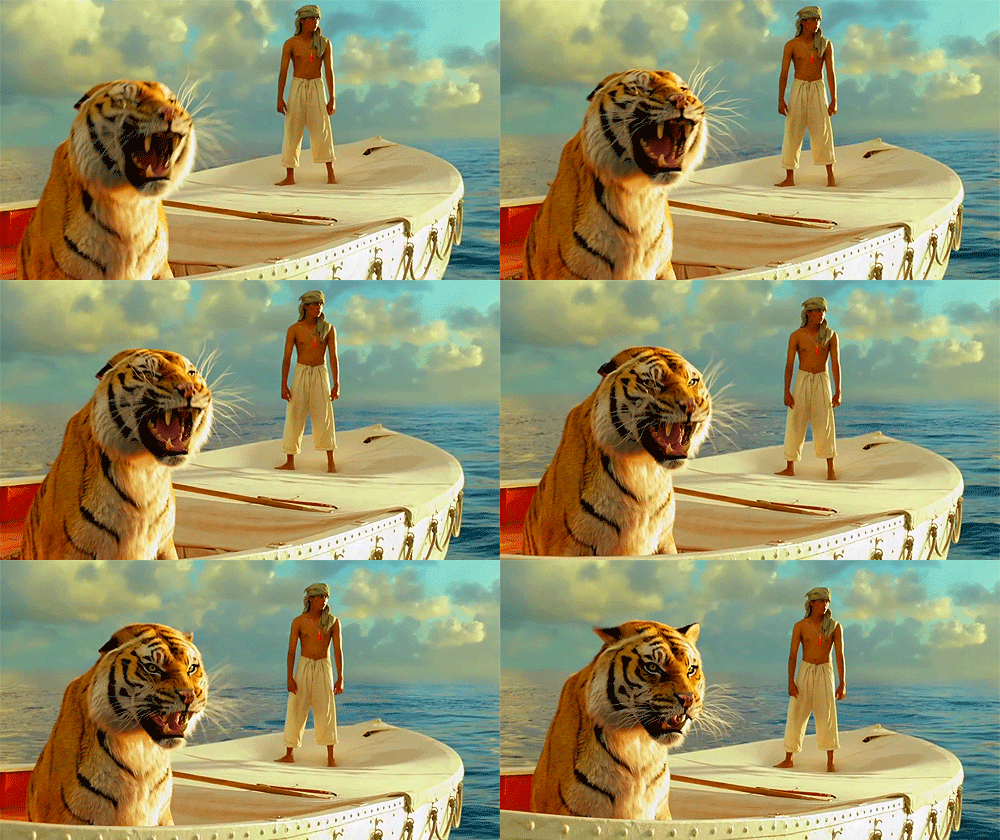
The novel begins with the author describing in an author’s note his travels to India, where he meets a man named Francis Adirubasamy in a coffeehouse in Pondicherry. His response to the author’s claim that he needs inspiration is “I have a story that will make you believe in God.” After which he refers the author to Piscine Patel in Toronto, who immediately begins to tell his own story, starting in Chapter 1.
As a teenager in Pondicherry,
India, Pi Patel describes his family – himself, his parents, and his brother
Ravi. He is constantly exploring new opportunities and learning many odd and
exciting things. His father is the proprietor of the Pondicherry Zoo, where Pi
learns much of the workings and raising of animals. Pi’s mother is an avid
reader and introduces to him numerous literary works from which he learns the
joys of numerous schools of thought. His school is filled with amazing
teachers, one of whom, Mr. Kumar is an inspiration to Pi.
Deriving his full name (Piscine)
from a world famous swimming pool in France, his parents are good friends with
Francis Adirubasamy (from the author’s note), a world class swimmer who often
goes on about the Piscine Molitor in Paris. He goes by Pi instead because his
schoolmates make a big deal out of calling him “pissing” instead as it sounds
similar. They all take to the name and from that point on, his name is no long
Piscine but Pi.
Pi grew up a Hindu, but
discovered the Catholic faith at age 14 from a priest by the name of Father
Martin. He is soon baptized. He then meets Mr. Kumar, a Muslim of some standing
and converts to Islam. Therefore, he openly practices all three religions
avidly. When the three religious teachers meet up with his parents at the zoo,
they demand that he choose a single religion, to which he announces he cannot.
Throughout this section, Pi discusses numerous religious matters as well as his
thoughts on culture and zoology.
At age 16, Pi’s father decides
that Mrs. Gandhi’s (the leader of India) political actions are unsavory and
closes up the zoo to move to Toronto. He sells off a majority of the zoo
animals to various zoos in America. The animals are loaded onto the same boat
that the family will take to reach Winnipeg, Canada. On the journey to North
America, the boat sinks.
As the only survivor of the
shipwreck, he’s stuck in a lifeboat with a dying zebra and a hyena. Pi sees
another survivor floating in the water and only after throwing them a life
preserver and pulling them aboard does he realize that “Richard Parker” is actually
the 400 pound tiger from his father’s zoo. He immediately jumps overboard until
he realizes that there are sharks nearby.
So, upon reentering the boat, he
wedges the tarpaulin up with an oar and decides he might survive if he can stay
on top and keep Richard Parker beneath it. Over the next week an Orangutan
arrives as well and the four animals interplay carefully, eating each other
until there is only Richard Parker left.
Over the course of the next 7
months aboard the lifeboat, Pi hides on a makeshift raft behind the boat and
begins the process of taming Richard Parker with a whistle and treats from the
sea, as well as marking his portion of the boat. He begins to get close to the
tiger, developing the kind of bond a zookeeper does with his menagerie. After a
while, Pi learns to kill and eat from the sea, sharing with the tiger. The two
do not eat nearly enough though and as time passes, they become quite ill.
At a certain point, the two
become so hungry and ill that they lose their sight and come across another
blind man amazingly floating along in the ocean as well. The two talk for a bit
about food and eventually the blind man tries to board Pi’s boat, intent on
eating him. However, when he boards the boat the unsuspecting man is attacked
by Richard Parker and eaten. The tears from the situation eventually clear up
Pi’s vision and they continue on alone in the boat.
Still floating along alone and
desperate, the two come across an island made of algae. They disembark and Pi
begins eating the algae, regaining his strength during the day and sleeping on
the boat. Richard Parker regains his strength from eating the meerkats who live
on the island, sleeping in the trees during the night. Eventually, Pi realizes
that they leave at night because of an acid produced by the island during the
night hours. He eventually notices a tooth among the algae, evidence of another
man having died on the island. They leave quickly as the island is apparently
carnivorous.
Finally, after more time spent
floating along in the ocean, Pi sights land in Mexico and disembarks. Richard
Parker immediately runs off into the woods and Pi is recovered by two men from
the shipping company who owned the boat that sank with his family on it. He
relates to them the story of his 227 days on the boat, but they do not quite
believe his fantastic tale of surviving with a Bengal Tiger and meeting a blind
man in the ocean.
So, Pi relays to them a second
story instead of his mother, a sailor with a broken leg and a cannibalistic
cook, with no animals and no magical islands this time around. The story
closely parallels the first story without all of the fancy involved, and one of
the men points this out. However, the two ignore the final story in favor of
the better story and write it up in their report after Pi mentions that it does
not matter as both lead to the same outcome.
Summary by: Nur Sarah Akmal
Labels: Nur Sarah Akmal


